Why Paying Off Debt Feels Harder Than It Should Be
6 October 2026
You know the math. You have seen the numbers. If you throw an extra $300 at that credit card every month, the balance dies in a couple of years and you save a small fortune in interest. Simple. Clean. Satisfying.
So why does it feel like you are dragging a boulder up a hill while wearing flip-flops?
Because debt repayment is not a math problem. It is a behavior problem dressed up in a spreadsheet costume. The arithmetic is the easy part. The hard part lives in your head, your habits, your paycheck timing, and a financial system that quietly profits when you stay confused. Let's dig into why this is so much harder than it should be, and what you can actually do about it.

The Math Is Honest. Your Brain Is Not.
Personal finance gurus love to say "just pay it off." That advice ranks somewhere between "just run a marathon" and "just write a novel" on the usefulness scale. Technically true. Practically useless without a plan for the messy middle.Here is the core tension: debt repayment requires you to sacrifice something real today for a benefit you cannot see yet. Your brain, evolutionarily speaking, is not built for that trade. It is built for "there is a threat right now, deal with it" and "there is cake right now, eat it."
This is not a character flaw. It is a design feature that happens to work against you in a world of 24 percent APR credit cards and one-click checkout.
Present Bias: The Villain Nobody Talks About
Present bias is the tendency to value immediate rewards more than future ones. It is why you order takeout on a Tuesday when you have groceries at home. It is why you skip the gym. And it is why, when you have $400 of discretionary money and a $6,000 credit card balance, part of you wants to book the weekend trip.The trip delivers joy in 48 hours. The debt payoff delivers relief in 18 months. Your brain votes for the trip. Every time.
The fix is not willpower. Willpower is a finite resource that gets depleted by 4 p.m. on a Wednesday. The fix is making the future benefit feel closer and more concrete. More on that later.
The Progress Paradox
When you owe $12,000, paying $500 feels like spitting into the ocean. The balance barely moves. Interest eats most of your effort. You do the right thing for three months and the number goes from $12,000 to $11,200. That is a terrible return on emotional investment.This is why so many people quit in month four. Not because they are lazy. Because the feedback loop is broken. You are doing hard work and seeing almost nothing.
Compare that to saving. Put $500 in a savings account and it says $500. Put $500 toward debt and it says $11,500. One feels like progress. The other feels like a rounding error.
The trick is to measure the right thing. More on that in the strategy sections.

The System Is Not Exactly Rooting for You
Let's be clear-eyed about this. The consumer credit industry is built on the assumption that a meaningful percentage of people will carry balances and pay interest. That is not a conspiracy theory. It is a business model.Credit card issuers make money three ways: swipe fees, annual fees, and interest. Interest is the big one. If everyone paid their balance in full every month, the economics of many rewards programs would collapse. Those 2 percent cash back offers are funded in part by the interest paid by people who carry balances.
This matters for one reason: the system is designed to make minimum payments feel normal. Your statement shows a minimum payment that is engineered to keep you in debt for decades while keeping your account in good standing. It is not designed to free you. It is designed to retain you.
Recognizing this is not about anger. It is about clarity. You are not fighting your own laziness alone. You are fighting a machine optimized to keep you paying.

The Real Reasons It Feels Impossible (and What to Do)
Let's get specific. Here are the forces working against you, and practical ways to counter each one.Reason 1: You Are Paying in the Wrong Order
Most people pay the minimum on everything and then throw extra money at whichever account is loudest in their head. Usually the biggest balance, because it feels like the "real" problem.This is backwards, and it costs you money.
There are two proven methods:
The avalanche method targets the highest interest rate first. It saves the most money mathematically. If you have a 26 percent store card and a 6 percent student loan, you attack the store card with everything you have while paying minimums elsewhere.
The snowball method targets the smallest balance first. It costs a bit more in interest but delivers a psychological win faster. Paying off a $400 medical bill in month two gives you momentum to keep going.
Which one wins? Research on debt repayment behavior has generally found that people who use the snowball method are more likely to stay with the process and eliminate balances, even though it is not the cheapest option on paper. The best method is the one you actually finish.
My recommendation: if you have one small balance under $1,000, snowball it first for the win. Then switch to avalanche. You get the emotional fuel and the mathematical efficiency.
Reason 2: Your Budget Is a Fantasy Novel
You wrote a budget. It was beautiful. It had categories like "dining out: $150" and "miscellaneous: $100." It survived for nine days.The problem is that most budgets are built for the person you wish you were, not the person you are. They assume perfect adherence. They ignore irregular expenses like car repairs and annual insurance premiums. They have no buffer for the birthday party you forgot about.
A better approach: build a budget around your actual spending, not your aspirational spending. Track everything for 30 days. No judgment. Then look at the numbers and ask one question: "What can I cut that I will not miss?"
Most people find $200 to $400 in spending they genuinely do not care about. Not the coffee. Not the gym. The stuff they cannot even remember buying.
Reason 3: You Are Fighting Variable Income With Fixed Obligations
If you are a freelancer, a commission-based worker, or someone with irregular hours, the standard debt payoff advice falls apart. You cannot "automate" a payment when you do not know what is coming in next month.The fix is a two-tier system. Set your minimum payments on autopay from a baseline account. Then, when a good month happens, make a lump-sum payment toward your target debt. Do not wait for a perfect month. Do not wait for a raise. Use the surplus when it appears.
This is not as clean as a fixed plan. It is more honest. And it works.
Reason 4: You Have No Emergency Buffer, So Every Surprise Becomes New Debt
Here is the cycle: you pay $800 toward your credit card. Your car needs a $700 repair. You put it on the card. You are now $100 worse off than before, plus you feel like an idiot.This is the single most common reason debt payoff stalls. It is not overspending on fun. It is the absence of a buffer.
Before you attack debt aggressively, build a small emergency fund. One month of essential expenses is enough to start. Some experts say $1,000. I think that is too low for most people in 2024. Aim for one month of rent, utilities, groceries, and transportation.
Yes, this delays your debt payoff by a few months. Yes, it feels wrong. Do it anyway. The alternative is a treadmill.
Reason 5: Your Creditors Are Not All Equally Dangerous
Not all debt is created equal. A 3 percent mortgage is a very different animal from a 29 percent payday loan. Treating them the same is a mistake.Here is a rough hierarchy of danger:
- Payday loans and title loans: These are financial emergencies. Prioritize them above almost everything.
- Credit cards and store cards: High interest, revolving, and psychologically sticky. Attack these hard.
- Personal loans: Moderate interest, fixed term. Less urgent but still worth prioritizing.
- Student loans: Often lower interest, sometimes tax-advantaged. Federal loans have protections private loans do not.
- Auto loans: Secured by a depreciating asset. Pay on schedule unless the rate is high.
- Mortgage: Usually the lowest rate and the only debt with a potential tax deduction. Do not rush to pay this off before you have eliminated higher-interest debt.
The common mistake: paying extra on a 3 percent mortgage while carrying a 24 percent credit card. That is lighting money on fire to feel virtuous.
Reason 6: You Are Trying to Do It Alone
Money is the last taboo. People will discuss their sex lives before their credit card balances. That silence is expensive.When you tell no one about your debt, you cannot get help, you cannot get accountability, and you cannot get perspective. You also cannot hear from someone who has been exactly where you are and made it out.
You do not need to broadcast your balance on social media. But you do need at least one person who knows the real numbers and checks in on you. A partner, a sibling, a friend, a therapist, a debt counselor. One person.
Reason 7: Your Environment Is Designed to Extract Money
You are not weak. You are outgunned.Apps have teams of engineers optimizing for your clicks. Stores have layouts designed to make you walk past things you did not know you wanted. Credit card offers arrive pre-approved. Buy-now-pay-later buttons appear at checkout. Your phone knows when you are bored.
Willpower is not a fair fight against this. Systems are.
Practical countermeasures:
- Remove saved card numbers from shopping apps.
- Unsubscribe from retail emails. All of them.
- Use cash or a debit card for discretionary spending.
- Implement a 48-hour rule for any non-essential purchase over $50.
- Turn off one-click ordering.
None of these are dramatic. Together, they change your default behavior.
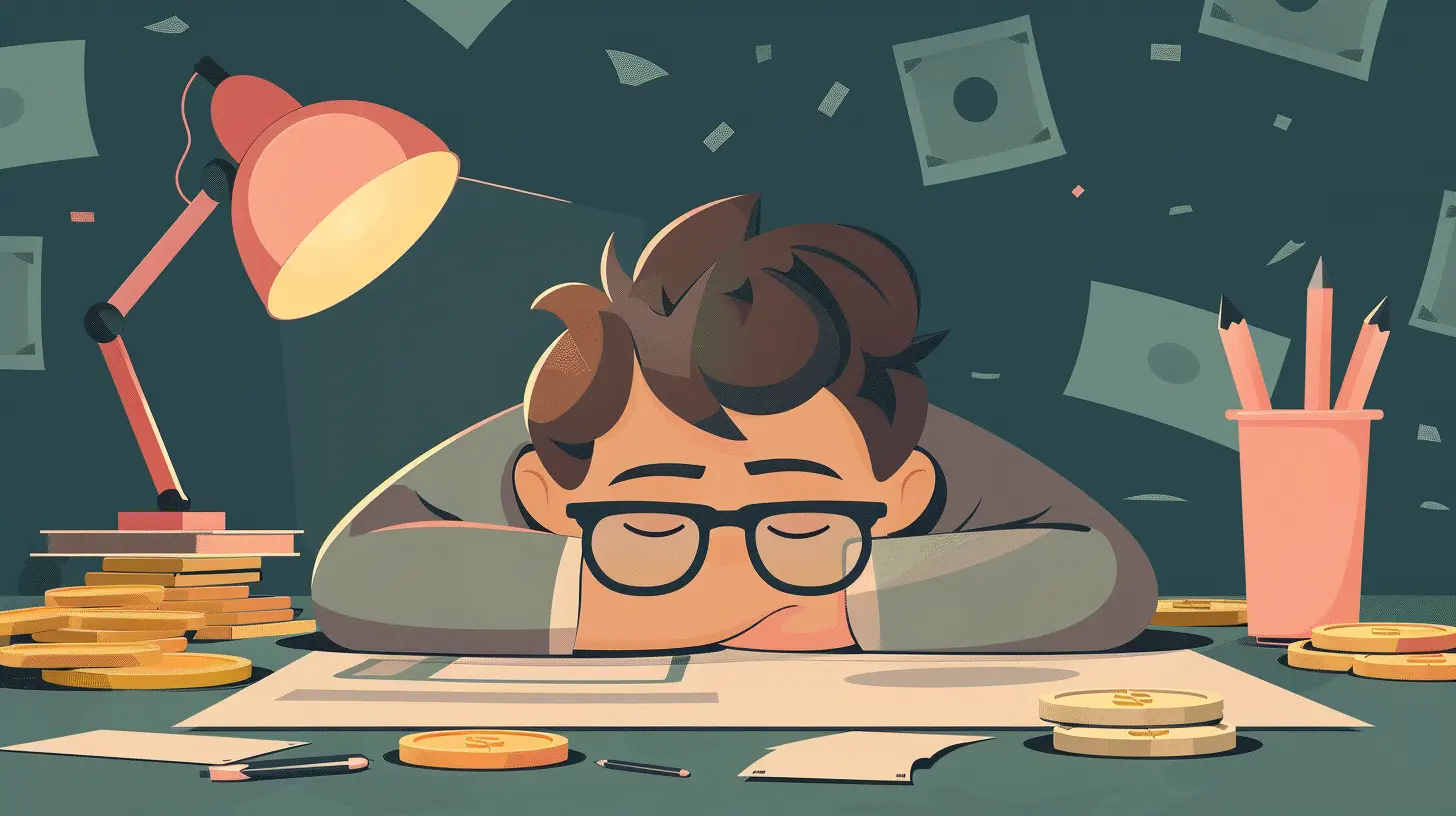
The Emotional Weight Nobody Warns You About
Debt is not just a number. It is a story you tell yourself about who you are. And that story can be brutal.Shame is the most common emotion attached to debt. Shame says "I am bad with money" instead of "I made some decisions that did not work out." Shame leads to avoidance. Avoidance leads to not opening statements. Not opening statements leads to missed payments and worse outcomes.
If you recognize this pattern, the first move is not a budget. It is a reframe. You are not a bad person. You are a person with a balance. Those are different things.
The second move is to open the statements. All of them. Today. Write down every balance, every interest rate, every minimum payment. The number might scare you. The not knowing is worse.
What Actually Works: A Realistic Framework
Let's put this together into something you can use.Step 1: Get the full picture
List every debt: creditor, balance, interest rate, minimum payment, due date. Put it in a spreadsheet or on paper. This is your baseline. No judgment.Step 2: Build a one-month buffer
Before aggressive payoff, save one month of essential expenses. Keep it in a separate account. This is not an investment. It is a shock absorber.Step 3: Choose your method
If you have a small balance under $1,000, snowball it first. Then switch to avalanche. If all your balances are large, go avalanche from the start.Step 4: Automate the minimums
Set every minimum payment on autopay. You will never miss a due date. You will never pay a late fee. This is non-negotiable.Step 5: Attack with variable income
Throw every surplus dollar at your target debt. Tax refund. Bonus. Side gig. Birthday money. Do not wait for a perfect month. Use what you have.Step 6: Track the right metric
Do not track your balance. Track your "debt-free date." Recalculate it every month. Watching that date move closer is far more motivating than watching a number shrink slowly.Step 7: Protect the plan
Review your progress monthly. Adjust as needed. Do not abandon the plan because of one bad month. A bad month is data, not failure.
Common Mistakes and Misconceptions
Mistake: Closing paid-off credit cards. This can hurt your credit score by reducing your available credit and shortening your credit history. Keep the card open with a small recurring charge you pay in full. Or leave it open with no balance if there is no annual fee.Mistake: Using balance transfers without a plan. A 0 percent balance transfer can be a powerful tool. It can also be a trap if you do not pay off the balance before the promotional period ends. The retroactive interest can be brutal. Only do this if you have a clear payoff timeline.
Mistake: Raiding retirement to pay debt. This is almost always a bad idea. You lose compound growth, you may pay penalties and taxes, and you cannot borrow for retirement. There are rare exceptions, but they are rare.
Misconception: "I will start when I earn more." You will not. Lifestyle creep is real. The best time to build the habit is now, at your current income.
Misconception: "Debt payoff should feel good." It often does not. It feels like deprivation for a long time. The good feeling comes later. Expect the grind. It is part of the process.
When to Get Help
Sometimes the hole is too deep to climb out alone. That is not failure. That is math.Consider professional help if:
- Your minimum payments exceed 20 percent of your take-home pay.
- You are using debt to pay debt.
- You are behind on secured debts like your mortgage or car loan.
- You feel hopeless or paralyzed.
Options include nonprofit credit counseling, debt management plans, and in serious cases, bankruptcy. Bankruptcy is not a moral failure. It is a legal tool designed for exactly this situation. It will damage your credit for years, but it can also give you a fresh start that is impossible otherwise.
Talk to a nonprofit counselor before you talk to a debt settlement company. Settlement companies often charge high fees and can make your situation worse.
The Bottom Line
Paying off debt feels harder than it should because it is harder than it should be. You are fighting present bias, a system designed to keep you paying, a culture that treats money as taboo, and a brain that wants the reward now.None of that means you cannot do it. It means you need a plan that accounts for the human being you actually are, not the spreadsheet robot you wish you were.
Start with the full picture. Build a small buffer. Pick a method. Automate what you can. Track your debt-free date. Get one person in your corner. Protect the plan through bad months.
It will still be hard. But it will be possible. And that is a very different thing.
all images in this post were generated using AI tools
Category:
Paying Off DebtAuthor:

Audrey Bellamy